
Start-ups are expected to bring smart jobs and growth for tomorrow. Turning their backs on aging social mass movements, our younger generations take the plunge in technological waters with the support of cohorts of business angels and venture capital companies, many of them eager to tap the potential of infinite returns on investments. Universities and schools are also pushing the very best of their graduates towards entrepreneurship. After decades of preference for civil service, France is becoming proud of its Masters d’Entrepreneuriat, an indicator of a start up revolution that has taken place even more strongly in this country than in Germany, our neighbor where youth unemployment is hitting less.
But roses don’t bloom without thorns. The start-up process remains a tricky process. As recently commented by the CEO of Slite, a French start-up, “Don’t try to prevent failures in the process, they will happen anyway, just manage your brains to extract the very best solution possible whenever a new problem arises!”. The Economist, in its June 2018 first week release, titled “the future of the tech start-ups, in the danger zone”. The risk is high that internet start-ups be caught up in the “embrace, extend, extinguish or kill zone” if their path happens to cross the path of big contenders. Not in all cases will this translate into a sad end for their entrepreneurs, some of them selling their stocks at a price, but the community would be frustrated from missed opportunities of today start-ups becoming the Daimler, Michelin, Renault, GAFAs, Louis Vuitton of tomorrow.
Are French start-ups better suited to withstand such domination?
Maybe one key factor of success for a start-up would come from its power of disruption either thanks to the design, or to the manufacturing process, or to the consumer pattern, or to the distribution. Last week, l’Institut Français de la Mode, one of the most celebrated institutes in France hosted start up projects invited to pitch on their ability to “develop, enhance, and promote a universe with creative potential”. What was at stake was the competitive edge to be obtained by converting a design into a brand new approach fully consistent with long-term market trends. That is one obvious criterion to buy time and get away from the “Kill Zone” as defined by The Economist.
From this perspective, and given its somehow alternative way of life, France probably offers a kind of buffer against such “Kill Zone” threat.
It would nevertheless be quick to say that it is enough. The quality of the business plan also plays its part. And to paraphrase Napoleon speaking about the art of war, a start up success story would be the result of a “simple art but all of execution”.
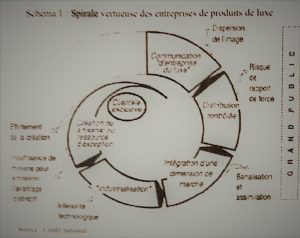
One representation of the start-up critical path is given by the “Spirale Vertueuse” which is a legacy from Crédit national, in 1992, at a time when this institution wanted to describe challenges and pitfalls ahead of start-ups storys in the luxury goods industry, from design to manufacturing, from manufacturing to branding, from branding to distribution, from distribution to consumer, and back again to design. This “Spirale Vertueuse” (“Rapport sur les industries du Luxe”) has been celebrated as self explanatory by the Conseil Economique et Social et Environnemental (“Le luxe, production et services“, February 13th, 2008 please see picture below).
Dominique F. Pasquier